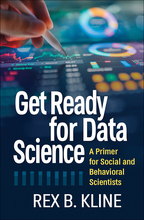
Get Ready for Data Science
A Primer for Social and Behavioral Scientists
Rex B. Kline
Hardcovere-bookprint + e-book
Hardcover
orderAugust 20, 2026
ISBN 9781462563494
Price: $80.00 528 Pages
Size: 7" x 10"
 Request a free digital professor copy on VitalSource ?
Filling a key need, this book provides a gateway to modern data analytics written expressly for social researchers and students. Rex B. Kline builds on readers’ statistical strengths and fills in the gaps from their traditional training. Chapters on programming, data visualization, big data, and supervised and unsupervised machine learning emphasize concepts over equations and feature rich graphics, including 11 color plates. Throughout, worked-through examples with real and simulated data, along with detailed interpretation of the R code and output, prepare readers to apply the techniques. Kline also provides pointers on the pitfalls and advantages of different statistical and data science techniques and explores incorrect interpretations. The companion website supplies R-generated syntax, output, and graphics files for the book's examples; complete data sets; chapter appendices with explanations of the syntax files; and primers on bivariate and multiple regression fundamentals, standard errors and classical significance tests, and data screening and preparation.
Pedagogical Features
Pedagogical Features
- Chapter-opening objectives and key concepts.
- End-of-chapter summaries.
- Exercises with end-of-book answers.
- Annotated suggested readings.
- Key terms for review.
“This book offers a thorough, accessible introduction to key concepts in data science, combining theoretical grounding with practical application. It includes clear explanations, code examples, and exercises that will benefit both students and professionals looking to strengthen their data science knowledge. Placing supervised and unsupervised machine learning later in the book allows readers to build the necessary intuition and technical foundations before tackling complex models. Kline does an excellent job balancing depth with clarity. The emphasis on conceptual understanding adds pedagogical value.”

—Nir Kshetri, PhD, Department of Management, University of North Carolina at Greensboro
“This text offers a comprehensive, well-structured overview of key data science concepts, bridging traditional statistical thinking with modern machine learning and computational approaches. The examples, figures, and appendices provide meaningful reinforcement of the chapter content, contributing significantly to the book's instructional value. Code examples are well annotated and easy to follow, with clear flow that reflects careful attention to reader comprehension. I commend the author for his thoughtful integration of code and narrative (which is no small task!).”
—Sarah Depaoli, PhD, Department of Psychological Sciences, University of California, Merced
“Get Ready for Data Science is the most comprehensive data science book available for behavioral science students and professionals. The narrative writing style is a strong feature of the text. The R code and output figures with detailed interpretation help students learn how to implement the analytical techniques and interpret the outputs.”
—Toshiyuki Yuasa, PhD, Hobby School of Public Affairs, University of Houston
“I appreciate that Kline begins by providing foundational knowledge and developing the reader's understanding of up-to-date statistical methods, rather than jumping right into tools and technical skills. The coverage of topics is excellent—I would recommend this book to any early-career researcher.”
—Glenn Williams, PhD, School of Psychology, Northumbria University, United Kingdom
Table of Contents
Introduction
I. Classical Statistics and Data Science
1. Ready Set Go
2. Classical Statistics
3. Data Science
II. Dispelling Myth and Alternatives
4. Estimating Uncertainty
5. Avoiding Insignificance
6. Lessons from Regression
7. Bayesian Basics
III. Programming and Data
9 Data Visualization
10. Big Data
11. Data Reduction
IV. Machine Learning and Beyond
12. Supervised Machine Learning: Core Methods
13. Supervised Machine Learning: Hyperparameter Tuning
14. Supervised Machine Learning: Complex Effects
15. Unsupervised Machine Learning
16. Other Data Science Horizons
Suggested Answers to Exercises
References
Author Index
Subject Index
About the Author