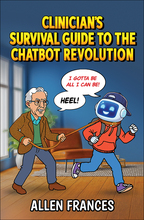
Clinician's Survival Guide to the Chatbot Revolution
Allen Frances
 Digital professor copy available on VitalSource once published ?
“Frances has had a long and storied career in American psychiatry, but this may be his most important book yet. With characteristic clarity, skepticism, and concern for patients, he confronts a technological revolution that is already transforming mental health care. Used wisely, chatbots can be remarkably useful assistants, but used autonomously, they can mislead, reinforce pathology, invade privacy, and displace the human relationship at the heart of treatment. From a dynamic standpoint, a chatbot may gratify the wish for an endlessly available, nonjudgmental other—but precisely for that reason, it can become an alluring substitute for the difficult, reality-based work of psychotherapy. Essential reading for clinicians and students alike, this is a book that every professor of psychiatry, psychology, social work, and counseling should place in the hands of their trainees.”

—Mark L. Ruffalo, LCSW, Assistant Professor of Psychiatry and Director of Psychiatry Residency Psychotherapy Training, University of Central Florida College of Medicine
“A most important contribution to the field of psychotherapy. Frances provides practitioners with much-needed information and guidelines on how AI can be used and misused in providing psychological help to patients. Arguing for a collaborative alliance among therapist, patient, and chatbot, this is an invaluable guide for how we need to conduct therapy in the future.”
—Marvin R. Goldfried, PhD, Distinguished Professor of Psychology (retired), Stony Brook University
“Frances has written a lucid, accessible guide to the brave new world of chatbots. Neither hyping nor downplaying the risks and benefits of chatbots, Frances charts a middle course, stressing the importance of careful collaboration between therapist and chatbot. This book will prove very useful to psychotherapists of all professional backgrounds, as well as to interns and residents in psychology and psychiatry training programs.”
—Ronald W. Pies, MD, Professor Emeritus of Psychiatry, State University of New York Upstate Medical University
“AI is part of mental health care, whether we are ready for it or not. Vibrant, cantankerous, funny, and opinionated, Frances has written a deeply humane guide to what comes next. Without hyperventilating about either possibilities or dangers, he asks the question that matters most: How can we put these powerful new tools in the service of people, rather than allowing people to be put in the service of tech? Frances emphasizes that human judgment, values, and relationships cannot be engineered away. After reading this eye-opening book, practitioners will be ready to use AI as an assistant, not a replacement. This is a remarkable and timely book about what seemed futuristic just yesterday—but has now arrived.”
—Steven C. Hayes, PhD, Foundation Professor of Psychology Emeritus, University of Nevada, Reno
“Frances has spent the past few decades warning about threats to mental health, coming from both within and outside of psychiatry. In this book, he tackles the timely topic of AI chatbots, striking a reasoned balance between their potential utility and their foibles, fallibility, and risk of significant harm. Frances covers a range of key issues related to chatbots and mental health, including anthropomorphism and sycophancy, effects on psychiatric disorders and learning, how to use better use chatbots as clinicians and consumers, and what we can all do to push back against the unbridled, for-profit hype of the AI chatbot industry. As always, Frances's writing is thought-provoking and eminently approachable, with lots of sound guidance that comes from a perspective of both expertise and intellectual humility about an unknown future.”
—Joe Pierre, MD, Health Sciences Clinical Professor, Department of Psychiatry and Behavioral Sciences, University of California, San Francisco
“Reading this book is essential if you want to remain (or become) a mental health care provider, advocate, accreditation board member, or health care administrator. For better or worse, many patients already have used—and potentially all future patients will use—chatbots to help them with their psychological problems. Frances offers a wealth of information about AI and provides commonsense ideas for collaborating with patients to make use of the best chatbots have to offer, avoid their worst mistakes, and train them to be useful therapy assistants. Don’t fall into the trap of assuming therapists will be able to provide traditional therapy in the future. You need to read this book now.”
—Judith S. Beck, PhD, President, Beck Institute for Cognitive Behavior Therapy
“AI is frequently described as either the savior or destroyer of human civilization—but aspects of both visions are likely to be proven correct. Allen Frances, one of the world’s most distinguished psychiatrists, considers both sides in his exploration of the use of chatbot technology by people desperately seeking better mental health. Readers will encounter 'ripped from the headlines' descriptions of chatbots that facilitate and encourage suicide, sexual predation, and scams. But clinicians will also find a very carefully conceived, intuitively sensible program for constructively incorporating chatbots into psychotherapy. This approach will almost certainly be the future of psychotherapy—every clinician will want to become familiar with Frances's recommendations.”
—David H. Barlow, PhD, ABPP, Professor Emeritus of Psychology and Psychiatry and Founder, Center for Anxiety and Related Disorders, Boston University
“Frances has been one of psychiatry’s most influential and provocative voices for decades, as chair of the DSM-IV Task Force and as a forceful critic of diagnostic inflation, the blurring of boundaries between ordinary distress and mental disorder, and the rigid application of psychiatric categories. He now turns his attention to what is unquestionably one of the most consequential challenges facing mental health care. Frances is alert to both the promise of chatbots—including accessibility, immediacy, and reach—and their serious risks. The challenge is not simply whether clinicians should accept or reject chatbots, but how we can shape their use: preserving the distinctively human elements of care and insisting on clinical accountability, regulation, privacy protection, and reliable safeguards. Full of useful, practical details, the book includes case studies and suggestions for adapting and improving chatbots to be more beneficent partners in therapy instead of stand-alone, money-making, potentially dangerous proxies. This is essential reading for mental health clinicians and anyone concerned with the future of mental health care.”
—S. P. Sashidharan, MBBS, MRCPsych, MPhil, PhD, Consultant Psychiatrist, United Kingdom National Health Service
Table of Contents
I. Creating Chatbots in Our Own Image
2. Chatbot Dreams and Chatbot Nightmares
3. Chatbot Past and Chatbot Future
4. Chatbot Thinking and Human Thinking
5. Chatbot Genius and Chatbot Jackass
6. Meet a Great Chatbot Therapist
7. Chatbot Therapy: The Good, the Bad, and the Ugly
8. Meet the Casualties of Awful Chatbot Therapists
II. The Clinician’s Guide
9. Getting Started
10. Training Your Chatbot Assistant
11. How Do We Avoid Being Replaced by Chatbots?
12. Our David versus Their Goliath
13. Chatbot Predators and Chatbot Victims
14. Chatbot Privacy Is an Oxymoron
15. Retraining Our Training Programs
16. Resolving Disagreements
17. Mastering Our Uncertain Future
18. My Advice for Patients
Addendum: Ten Crucial Debates We Should Be Having (and Aren’t)
Afterword
Acknowledgments
References