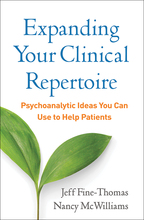
Expanding Your Clinical Repertoire
Psychoanalytic Ideas You Can Use to Help Patients
Jeff Fine-Thomas and Nancy McWilliams
HardcoverPaperbacke-bookprint + e-book
Hardcover
pre-orderJanuary 1, 2027
ISBN 9781462565399
Price: $60.00 190 Pages
Size: 6" x 9"
Paperback
pre-orderDecember 4, 2026
ISBN 9781462565382
Price: $40.00190 Pages
Size: 6" x 9"
e-book
pre-orderDecember 4, 2026
PDF and Accessible ePub ?
Price: $40.00 190 Pages
ePub is Global Certified Accessible
print + e-book $80.00 $48.00
pre-orderPaperback + e-Book (PDF and Accessible ePub) ?
Price: 190 Pages
ePub is Global Certified Accessible
 Digital professor copy available on VitalSource once published ?
How do I help particular patients to become more psychologically minded? How do I understand the meanings behind their communications? What can I do to reestablish the therapeutic alliance after a rupture in the relationship? From master clinicians, this uniquely integrative guide presents contemporary psychodynamic ideas and techniques to expand any therapist's clinical repertoire, regardless of orientation. Jeff Fine-Thomas and Nancy McWilliams explain how psychoanalytic principles can aid in making sense of a client's presenting problems, positioning treatment for success, overcoming common roadblocks, and fostering meaningful growth. Brief vignettes and chapter-length case examples illustrate ways to weave carefully selected psychodynamic strategies into the beginning, middle, and end phases of treatment.
“This is the book that practitioners who are curious about psychoanalytic approaches—but who don’t have the time to devote to formal analytic training—have been waiting for! Fine-Thomas and McWilliams adeptly translate psychoanalytic concepts into practical, jargon-free principles, and demonstrate applications in modern-day practice. This is not a manualized 'how-to' book; rather, it highlights the importance of therapy as a humanistic practice that is responsive and adaptive to patients where they are. This book will be particularly valuable to clinicians trained in cognitive and/or behavioral approaches who seek an integrative approach to their work. Fine-Thomas and McWilliams do a masterful job of breaking down silos, fostering respect and collaboration across the spectrum of theoretical orientations.”

—Shirley Yen, PhD, Training Director, Clinical Psychology Internship Program, Massachusetts Mental Health Center; Associate Professor, Department of Psychiatry, Harvard Medical School
“Since its inception, psychotherapy has been divided into an ever-increasing number of separate and competing schools. Fine-Thomas and McWilliams provide important stepping stones toward achieving greater consensus in the field in this excellent volume. While the book describes psychodynamic principles, processes, and interventions, the primary focus is what is useful to therapists of all orientations. This is a most thoughtful volume, to be read by beginning and experienced therapists alike.”
—Marvin R. Goldfried, PhD, Distinguished Professor of Psychology (retired), Stony Brook University
Table of Contents
PrefaceIntroduction
1. Basic Goals and Vital Signs of Progress
2. Clinically Useful Psychoanalytic Concepts
3. Psychodynamic Approaches to Beginning Treatment
4. Therapeutic Principles
5. Psychodynamic Work with Healthier Patients: Anna
6. Psychodynamic Therapy of More Challenging Patients: Mary
7. Facing Contemporary Challenges Together
References
Index
About the Authors
Jeff Fine-Thomas, MA, LMFT, is a psychotherapist and clinical consultant in private practice in Oklahoma. He started his career working in an inpatient setting, then transitioned to clinical work with college students at Eastern Nazarene College. He held a nonclinical position at the Harvard Macy Institute at Harvard Medical School prior to starting full-time private practice. He also taught Professional Orientation (ethics) at Southern Nazarene University and worked in their university counseling center. Mr. Fine-Thomas is a member of and has served as treasurer, vice president, and president of the Oklahoma Society for Psychoanalytic Studies, and taught in their Foundations series for many years.Nancy McWilliams, PhD, ABPP, is Visiting Professor Emerita at the Graduate School of Applied and Professional Psychology at Rutgers, The State University of New Jersey, and has a private practice in Lambertville, New Jersey. She is author or editor of acclaimed books, including Psychoanalytic Diagnosis, Second Edition, and has published widely in professional journals. Dr. McWilliams is a past president of the Society for Psychoanalysis and Psychoanalytic Psychology, Division 39 of the American Psychological Association (APA). She is the recipient of honors including the Gradiva Award from the National Association for the Advancement of Psychoanalysis, the Erikson Scholar Award from the Austen Riggs Center, the Goethe Scholarship Award from the Section on Psychoanalytic and Psychodynamic Psychology of the Canadian Psychological Association, the Rosalee Weiss Award from the Division of Independent Practitioners of the APA, the Laughlin Distinguished Teacher Award from the American Society of Psychoanalytic Physicians, the Hans H. Strupp Award from the Appalachian Psychoanalytic Society, and the International, Leadership, and Scholarship Awards from APA Division 39. She is an honorary member of the American Psychoanalytic Association; the Institute for Psychoanalytic Psychotherapy of Turin, Italy; and the Warsaw Scientific Association for Psychodynamic Psychotherapy. Dr. McWilliams’s writings have been translated into more than 20 languages.
- Author's website
- All titles by Nancy McWilliams
- Sign up for emails on upcoming titles by Nancy McWilliams (with special discounts)!