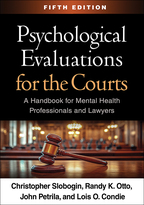
Psychological Evaluations for the Courts
Fifth Edition
A Handbook for Mental Health Professionals and Lawyers
Christopher Slobogin, Randy K. Otto, John Petrila, and Lois O. Condie
 Request a free digital professor copy on VitalSource ?
New to This Edition
- Updated empirical research on competency, interrogation practices, risk assessment, the effects of divorce on children, neurological and developmental science, and more.
- Recent court rulings, evidentiary rules, and regulatory shifts.
- Increased attention to race, culture, and culturally competent practice.
- New topics: the rise of remote evaluations, debates over recording evaluations, the trend toward privatization of forensic services, the use of social media data in investigations, implications of artificial intelligence for forensic practice, the “competency crisis,” substance abuse commitment, the Relevancy-Focused report format (including a new sample report), and more.
“A comprehensive, useful analysis of an array of topics relevant to forensic mental health practice.”

—Journal of the American Academy of Psychiatry and the Law (on the third edition)
“An authoritative text in the field of forensic psychology.”
—International Journal of Offender Therapy and Comparative Criminology (on the third edition)
“Offers a comprehensive discussion of forensic assessment along with best practice guidelines for psychological evaluations in a wide range of criminal and civil proceedings.”
—Juvenile and Family Court Journal (on the third edition)
“If you perform forensic evaluations for a living, you need this book.”
—Journal of Psychiatric Practice (on the third edition)
“The fifth edition of this canonical work fully captures the last decade's explosive growth in what courts demand of mental health experts. Seamlessly meshing scientific rigor, legal precision, and clinical acumen, this is the single most crucial work to read if there is a witness stand in your future. With the publication of this book, the goalposts for both scholarship and practice in forensic psychology have been shifted.”
—John Monahan, PhD, Shannon Distinguished Professor of Law and Professor of Psychology, University of Virginia
“Given its impressive scope, sophisticated legal analysis, and reliance on empirically supported practice, this is the definitive book for forensic mental health professionals as well as legal professionals who rely on psychological evaluations. Slobogin and colleagues have succeeded in writing a tour-de-force book that is simultaneously scholarly and practical. The fifth edition will surely become the go-to resource for students, mental health professionals, and legal professionals.”
—David DeMatteo, JD, PhD, ABPP, Department of Psychological and Brain Sciences and Thomas R. Kline School of Law, Drexel University
“One of the most foundational texts in forensic mental health assessment and mental health law. Its comprehensive review of relevant law, social science research, and practice makes this text an unparalleled resource for trainees and seasoned professionals alike. I reach for this book often to guide best practice and help resolve thorny ethical dilemmas. Readers familiar with prior editions will be pleased with the fifth edition—it includes robust reviews of new research in key areas (for example, the competency crisis) and recent developments in practice (for example, remote evaluations; Relevancy-Focused reports). This text is an absolute necessity for anyone practicing or learning about forensic mental health or mental health law.”
—Sharon Kelley, JD, PhD, Department of Psychiatry and Neurobehavioral Sciences, University of Virginia School of Medicine
“This text is not just a 'must read' but a 'must own' for forensic psychology students and practitioners. The fifth edition updates critical case law and addresses contemporary psycholegal issues in impressive depth. I have been teaching forensic assessment for over a decade, and this book continues to be the primary text I require for all of my graduate clinical psychology students. Without question, it is the definitive text on forensic psychological assessment.”
—Elizabeth Foster, PhD, Institute for Graduate Clinical Psychology, Widener University
Table of Contents
I. General Considerations
1. Law and the Mental Health Professions: An Uneasy Alliance 
1.01. The Context for Law and Behavioral Science
1.02. Some Preliminary Problems in Law and Mental Health
1.03. Paradigm Conflicts
1.04. Should Mental Health Professionals Be Considered Experts?
1.05. Which Professionals Should Be Considered Experts?
1.06. Conclusion
2. An Overview of the Legal System: Sources of Law, the Court System, and the Adjudicative Process
2.01. Introduction
2.02. Sources of Law
2.03. The Court System
2.04. The Adjudicative Process
2.05. Conclusion: The Interplay of Systems
3. The Nature and Method of Forensic Assessment
3.01. Introduction
3.02. Distinctions between Therapeutic and Forensic Assessment
3.03. Testing and Assessment Procedures
3.04. Archival and Third-Party Information
3.05. Amnesia
3.06. Assessment of Response Style
3.07. Cultural Competence
3.08. Challenges to the Basis of Expert Testimony
3.09. The Implications of Artificial Intelligence for Forensic Practice
3.10. Conclusion
4. Constitutional, Common-Law, and Ethical Contours of the Evaluation Process:
The Mental Health Professional as Double Agent
4.01. Introduction
4.02. The Fifth Amendment and the Right to Remain Silent
4.03. The Right to Counsel
4.04. Common-Law and Statutory Duties of the Evaluator
4.05. Ethical Considerations in the Evaluation Process
4.06. Summary: Competence in Forensic Practice
5. Managing Public and Private Forensic Services
5.01. Introduction
5.02. The Case for Specialization3
5.03. Types of Evaluation Systems for Criminal Cases
5.04. Establishing a Forensic Evaluation System
5.05. Effective Diffusion of Behavioral Science Research
5.06. Operating a Forensic Practice
II. The Criminal Process
6. Competence to Proceed
6.01. Introduction
6.02. The Legal Standard
6.03. Procedural Issues
6.04. Disposition of Incompetent Defendants
6.05. Competence During Proceedings Other Than Trial or Plea Hearings
6.06. Research Relating to Competence Evaluations
6.07. Structured Evaluation Formats
6.08. Special Populations
6.09. Guidelines for Evaluation
6.10. Conclusion
7. Other Competencies in the Criminal Process
7.01. Introduction
7.02. Competence to Consent to a Search or Seizure
7.03. Competence to Exercise the Right to Remain Silent
7.04. Competence to Plead Guilty
7.05. Competence to Waive the Right to Counsel and to Represent Oneself
7.06. Competence to Refuse an Insanity Defense and Other Mental State Defenses
7.07. Competence to Testify
7.08. Competence to Be Executed and to Participate in and Waive Appeals
8. Mental State at the Time of the Offense
8.01. Introduction
8.02. The Insanity Defense
8.03. Exculpatory and Mitigating Doctrines Other than Insanity
8.04. Research on the Relationship of Diagnosis to MSO Defenses
8.05. Characteristics of Clinicians’ MSO Opinions
8.06. MSO Investigation
8.07. Clinical Formulations about MSO
8.08. Conclusion
9. Sentencing
9.01. Introduction
9.02. A Brief History of Sentencing
9.03. A Comparison of Rehabilitative and Retributive Sentencing
9.04. Special Sentencing Provisions
9.05. Capital Sentencing
9.06. Factors Influencing Sentencing
9.07. Assessment of Treatment Needs
9.08. Assessment of Culpability
9.09. Assessing Risk of Violence and Recidivism
III. Noncriminal Adjudication
10. Civil Commitment
10.01. Introduction
10.02. History of Commitment Law
10.03. Substantive Criteria for Commitment
10.04. Procedural Due Process
10.05. The Effects of Commitment Laws and Commitment
10.06. Attorney’s Role
10.07. Clinician’s Role
10.08. Commitment Evaluation
10.09. The Process of the Evaluation
10.10. Special Commitment Settings and Populations
11. Civil Competencies
11.01. Introduction
11.02. Guardianship
11.03. Competence to Make Treatment Decisions
11.04. Competence to Consent to Research
11.05. Testamentary Capacity
12. Compensating Mental Injury: Workers’ Compensation and Torts
12.01. Introduction
12.02. Workers’ Compensation Law: An Overview
12.03. The Tort of Emotional Distress
12.04. Causation in Mental Injury Cases: A Paradigm Clash?
12.05. Clinical Evaluation of Mental Injury
12.06. Conclusion: Reports and Testimony
13. Federal Antidiscrimination, Entitlement, and Immigration Laws
13.01. Introduction
13.02. Americans with Disabilities Act
13.03. Fair Housing Amendments Act
13.04. Social Security Laws
13.05. Immigration Law
13.06. Conclusion
IV. Children and Families
14. Juvenile Delinquency
14.01. Introduction
14.02. The Rise and Fall of the “Therapeutic” Juvenile Court
14.03. The Nature of the Juvenile Process
14.04. Mental Health Professionals’ Roles in Juvenile Court116
14.05. The Nature of the Evaluation
14.07. Special Juvenile Populations
14.08. Do the Mental Health and Juvenile Systems Belong Together?
15. Child Abuse and Neglect
15.01. The Nature of Abuse and Neglect Proceedings
15.02. Legal Definitions of Child Maltreatment
15.03. Child Maltreatment as a Clinical Phenomenon
15.04. Clinicians’ Involvement in the Legal Process
15.05. Special Populations
15.06. The Methodology of Abuse/Neglect Evaluations
15.07. Adult Cases Related to Abuse and Neglect
16. Child Custody in Divorce
16.01. The Scope of Clinicians’ Involvement in Custody Disputes
16.02. Standards for Resolution of Custody Disputes
16.03. Research Data Relevant to Custody Matters
16.04. The Technique of Custody Evaluations
16.05. The Politics of Divorce
17. Education and Habilitation
17.01. Introduction
17.02. The Impetus for the IDEA
17.03. The Structure of the IDEA
17.04. Clinical Evaluation under the Act
17.05. Conclusion
V. Communicating with the Courts
18. Consultation, Report Writing, and Expert Testimony
18.01. Introduction
18.02. Preliminary Consultations
18.03. Data Collection, Maintenance, and Disclosure
18.04. Preliminary Report of Findings
18.05. Report Writing
18.06. Expert Testimony and the Social Psychology of Persuasion
18.07. The Ultimate-Issue Issue
18.08. Conclusion
19. Sample Reports
19.01. Introduction
19.02. Competence to Proceed
19.03. Competence to Plead and Waive Rights
19.04. Mental State at the Time of the Offense
19.05. Sentencing
19.06. Civil Commitment
19.07. Competence to Handle Finances
19.08. Workers’ Compensation for Mental Injury
19.09. Reasonable Accommodation under the Americans with Disabilities Act
19.10. Consultative Examination for Social Security
19.11. Immigration Status
19.12. Transfer to Adult Court
19.13. Dispositional Review
19.14. Custody
19.15. Evaluation under the Individuals with Disabilities Education Act
20. Glossary
20.01. Legal Terms
20.02. Clinical and Research Terms
Notes
Index
About the Authors
Christopher Slobogin, JD, LLM, is the Milton Underwood Chair in Law and an affiliate Professor of Psychiatry at Vanderbilt University Law School. He is the first and only law professor to receive Distinguished Contribution Awards from both the American Psychology–Law Society and the American Academy of Forensic Psychology. Professor Slobogin has published over 200 works on mental health law and criminal justice, and is currently one of the five most cited criminal law professors in the country. He served as chair of the task force revising the Criminal Justice Mental Health Standards of the American Bar Association (ABA) and as the Reporter for the ABA’s Task Force on Mental Disability and the Death Penalty and its Task Force on Criminal Responsibility.Randy K. Otto, PhD, MLS, ABPP, is Professor in the Department of Psychiatry and Behavioral Sciences at the University of New Mexico School of Medicine, where he serves as Chair of the Division of Forensic Behavioral Sciences. Board certified in clinical and forensic psychology, Dr. Otto has served as president of the American Psychology–Law Society, the American Board of Forensic Psychology, and the American Board of Professional Psychology. His contributions to forensic psychological assessment have been recognized with lifetime achievement awards from the American Academy of Forensic Psychology, the American Psychology–Law Society, and the forensic division of the New York State Psychological Association.
John Petrila, JD, LLM, is Senior Policy Advisor at Meadows Mental Health Policy Institute. Previously, he was Chair and Professor of Health Policy and Management at the University of South Florida College of Public Health. He is a recipient of a Fulbright Scholarship and of the University of South Florida President’s Faculty Excellence Award. Mr. Petrila’s research interests include the diversion of people with mental illnesses from the justice system, coercion, and strategies to reduce recidivism of heavy users of the treatment and justice systems. He is also a national expert on information sharing. Recent papers focus on emergency hospitalizations of people with mental illnesses, national review of emergency civil commitment legislation, the current status of the Americans with Disabilities Act, and use of the sequential intercept model as a tool for enhancing information sharing across the justice and behavioral health systems.
Lois O. Condie, PhD, ABPP, is affiliated with the Department of Neurology at Boston Children’s Hospital and is Assistant Professor of Psychology in Psychiatry at Harvard Medical School. Dr. Condie is board certified in neuropsychology, clinical psychology, and forensic psychology. She has received citations and awards from the University of Nebraska–Lincoln, the Social Security Administration, the American Board of Forensic Psychology, the American Academy of Forensic Psychology, and the American Board of Professional Psychology. Her research focuses on assessments and entitlement legislation for children with neurodevelopmental and other disorders, services for vulnerable populations internationally, psychological and legal conceptions of privacy, and ethics and standards of practice.
Audience
Practitioners and students in clinical and forensic psychology, social work, psychiatric nursing, and psychiatry; legal professionals and students.Course Use
Serves as a text in advanced undergraduate- and graduate-level courses such as Forensic Psychology, Forensic Assessment, Psychology and Law, and Psychology in the Courts.Previous editions published by Guilford:
Fourth Edition, © 2018
ISBN: 9781462532667
Third Edition, © 2007
ISBN: 9781572309661
Second Edition, © 1997
ISBN: 9781572302365
First Edition, © 1987
ISBN: 9780898622768
New to this edition:
- Updated empirical research on competency, interrogation practices, risk assessment, the effects of divorce on children, neurological and developmental science, and more.
- Recent court rulings, evidentiary rules, and regulatory shifts.
- Increased attention to race, culture, and culturally competent practice.
- New topics: the rise of remote evaluations, debates over recording evaluations, the trend toward privatization of forensic services, the use of social media data in investigations, implications of artificial intelligence for forensic practice, the “competency crisis,” substance abuse commitment, the Relevancy-Focused report format (including a new sample report), and more.