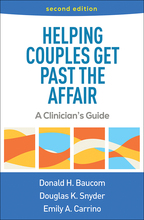
Helping Couples Get Past the Affair
Second Edition
A Clinician's Guide
Donald H. Baucom, Douglas K. Snyder, and Emily A. Carrino
 Digital professor copy available on VitalSource once published ?
New to This Edition
- Increased attention to different relationship types, orientations, and cultural diversity.
- Heightened focus on helping couples identify and honor their own relationship boundaries.
- Chapter on adapting treatment for various contexts, such as when only one partner seeks therapy or when one or both partners have complicating mental health concerns.
- Includes 24 reproducible/downloadable tools.
“The book provides guidance for therapists as they support clients in what is often a long and difficult process towards resolution of their issues.…This is a book that really looks at the work that is needed from an honest and realistic point of view and provides sensible suggestions for moving therapy forward. It will be a valuable addition to the bookshelf.”

—The Independent Practitioner (on the first edition)
“I like this book. It's straightforward and the procedures outlined in it make sound clinical sense to me....The authors offer a concrete approach to these troubled couples, and their book is peppered with case examples that are rich, illustrative, and all too familiar to this therapist. I recommend this book to anyone who works with families.”
—The Bulletin of the Menninger Clinic (on the first edition)
“Baucom, Snyder, and Carrino have provided us with an invaluable evidence-based guide to helping couples learn from and get past an affair. In clear, practical language, these master clinicians describe a flexible structure for three phases of treatment. They present broad therapeutic principles and goals that can be adapted to a variety of theoretical approaches and clinician styles. Particularly helpful are the lively, relevant case examples; the informative tables at the end of chapters; and the recommendations for using the authors' related self-help resource as an adjunct to therapy.”
—Susan H. McDaniel, PhD, ABPP, Dr. Laurie Sands Distinguished Professor of Families and Health, and Director, Institute for the Family, University of Rochester Medical Center
“This is the book I most often recommend to clinicians seeking guidance in one of the most challenging areas of couple therapy. The second edition integrates advances in relationship science, trauma-informed care, and evidence-based intervention into a compassionate framework for helping couples navigate the profound pain and complexity of infidelity. What sets this book apart is its remarkable balance of deep clinical wisdom and accessible, actionable strategies that therapists can immediately put into practice. It should be required reading in graduate courses and training programs focused on couple and family therapy. Few books so effectively illuminate a path from betrayal and broken trust toward healing, growth, and renewed connection.”
—Anthony L. Chambers, PhD, ABPP, Chief Academic Officer and Clinical Professor, The Family Institute at Northwestern and Northwestern University
“Without a doubt, this is the definitive work on treating couples facing infidelity. It offers a research-based, clinically road-tested framework that helps therapists move from 'What do I do now?' to 'I’ve got this!' The second edition addresses the rapidly changing worlds of online relationships and consensual nonmonogamy while placing renewed emphasis on establishing clear boundary expectations. The writing is wonderfully clear and even comforting for therapists managing their own stress while working with volatile couples in the crucible of infidelity.”
—William J. Doherty, PhD, Department of Family Social Science (Emeritus), University of Minnesota
“Helping couples heal from affairs can be overwhelming! New and seasoned therapists will breathe a sigh of relief as they read the evocative case examples and clinical dialogue in the second edition of this book. Baucom, Snyder, and Carrino offer a map to make sense of the chaos and the practical guidance needed to empathically structure a therapeutic process that delicately balances safety and the need to go beyond comfort zones. With a keen sense of timing and attention to both individual and relational responsibility, the authors capture how to help couples across relationship structures, life stages, cultures, and contexts move through the shattering hurt, anger, and confusion of affairs.”
—Carmen Knudson-Martin, PhD, LMFT, Marriage, Couple, and Family Therapy Program (Emerita), Lewis & Clark Graduate School
“This is the essential book for therapists about how to work with couples in the wake of affairs. Couple therapists have long struggled with how to bring a systemic approach to this major life crisis, about which opinions are plentiful and wisdom is rare. Baucom, Snyder, and Carrino present a masterful, integrative, evidence-based systematic approach, honed over decades. They superbly address both working through the crisis and exploring the complexities of this experience. The fully updated second edition reflects societal and technological changes and is filled with poignant examples and useful materials, such as letters that can be used as part of therapy. This brilliantly written book should be part of every couple therapist’s library.”
—Jay L. Lebow, PhD, ABPP, former Editor in Chief, Family Process
Table of Contents
PrefaceI. Preparing for Treatment
1. Conceptualizing an Integrative Treatment for Infidelity 
2. Initial Assessment and Conceptualization
3. Creating a Therapeutic Environment
II. Stage 1 of Treatment
Introduction to Stage 1 of Treatment
4. Damage Control
5. Restoring Equilibrium
6. Addressing Emotional Upheaval
III. Stage 2 of Treatment
Introduction to Stage 2 of Treatment
7. Preparing the Couple to Examine Contributing Factors
8. Examining Relationship Factors
9. Examining Outside Factors
10. Examining Individual Partner Factors
11. Tying It All Together
IV. Stage 3 of Treatment
Introduction to Stage 3 of Treatment
12. Addressing Challenges to Moving Forward
13. Complex Affairs
14. Moving Forward
15. Adapting Treatment for Various Contexts: Brief Interventions, Addressing Psychopathology, and Treating One Partner
16. Concluding Comments
References
Index
About the Authors
Donald H. Baucom, PhD, is Distinguished Professor Emeritus of Psychology and Neuroscience at the University of North Carolina at Chapel Hill, where he previously also served as Director of Clinical Psychology Training. His research and publications spanning over 50 years have helped to shape the field’s understanding of intimate relationships. As one of the originators of cognitive-behavioral couple therapy, Dr. Baucom helped develop and evaluate the efficacy of couple-based interventions for the treatment of relationship distress, recovery from infidelity, prevention of relationship discord, enhancement of satisfied relationships, and treatment of psychopathology in the couple context, as well as applications of couple-based interventions to a variety of health problems. He has served as Associate Editor for Behavior Therapy and on the editorial boards of numerous journals, and has conducted professional workshops on couple therapy around the world. Dr. Baucom is a recipient of the Mary G. Clarke Award for distinguished contributions to psychology from the North Carolina Psychological Association. Throughout his career, he has maintained an active clinical practice.Douglas K. Snyder, PhD, is Professor Emeritus of Psychological and Brain Sciences at Texas A&M University, where he served as Director of Clinical Training for 20 years. His research and publications focus on the assessment and treatment of couple relationships, with an emphasis on integrative approaches tailored to specific partner and relationship characteristics. Dr. Snyder has served as Editor of the Clinician’s Research Digest and as Associate Editor of the Journal of Consulting and Clinical Psychology and Journal of Family Psychology. He has worked extensively with the Departments of Defense and Veterans Affairs to train both chaplains and mental health professionals in helping couples recover from infidelity. Dr. Snyder is a recipient of the Distinguished Contribution to Research in Family Therapy Award from the Association for Marriage and Family Therapy, the Distinguished Contribution to Family Psychology Award from the Society for Couple and Family Psychology of the American Psychological Association (APA), and the Distinguished Psychologist Award from the APA's Society for the Advancement of Psychotherapy. He maintains an active clinical practice.
Emily A. Carrino, PhD, received her doctorate in clinical psychology from the University of North Carolina at Chapel Hill (UNC). Her research and publications on romantic relationships emphasize sociocultural factors in couples’ experiences of relationship distress, with a focus on sexual and gender minority populations. She explores how couples address boundaries and other complex domains in their intimate relationships and close communities. Dr. Carrino has served in various roles as a clinical psychologist, including as co-director of the couple therapy clinic at UNC, as a trainer and supervisor of couple therapists, and as an experienced couple therapist herself. She conducts national and international trainings in couple therapy, including having served as a consultant to the National Health Service in England and through the Behavioral Health Innovation and Dissemination Center at the University of Utah. Dr. Carrino has been recognized by UNC for her excellence in undergraduate teaching and for her service contributions in justice, equity, diversity, and inclusion.
Audience
Couple and family therapists and counselors, clinical psychologists, social workers, pastoral counselors, and psychiatrists.Course Use
May serve as a supplemental text in graduate-level courses.Previous editions published by Guilford:
First Edition, © 2009
ISBN: 9781609182397
New to this edition:
- Increased attention to different relationship types, orientations, and cultural diversity.
- Heightened focus on helping couples identify and honor their own relationship boundaries.
- Chapter on adapting treatment for various contexts, such as when only one partner seeks therapy or when one or both partners has complicating mental health concerns.
- Includes 24 reproducible/downloadable tools.