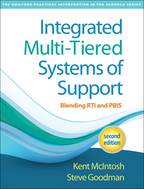
Integrated Multi-Tiered Systems of Support
Second Edition
Blending RTI and PBIS
Kent McIntosh and Steve Goodman
HardcoverPaperbacke-bookprint + e-book
Hardcover
pre-orderMarch 22, 2027
ISBN 9781462566211
Price: $81.00 307 Pages
Size: 8" x 10.5"
Paperback
pre-orderFebruary 22, 2027
ISBN 9781462564811
Price: $54.00307 Pages
Size: 8" x 10.5"
e-book
pre-orderFebruary 27, 2027
PDF and Accessible ePub ?
Price: $54.00 307 Pages
ePub is Global Certified Accessible
print + e-book $108.00 $64.80
pre-orderPaperback + e-Book (PDF and Accessible ePub) ?
Price: 307 Pages
ePub is Global Certified Accessible
 Digital professor copy available on VitalSource once published ?
This innovative guide to combining stand-alone academic and behavior supports into a single, integrated system is now in a thoroughly revised second edition, reflecting over a decade of advances in research and implementation. Many K–12 educators want to build integrated multi-tiered systems of support (MTSS) but lack a roadmap for doing so. This book provides step-by-step strategies and tools that are practical, equitable, field tested, and empirically based. The authors outline efficient, sustainable ways to integrate data structures, practices, teams, and district systems; detailed cases present examples of implementation. In a convenient large-size format, the volume includes dozens of reproducible checklists and forms that also can be downloaded and printed.
New to This Edition
New to This Edition
- Increased attention to supporting social–emotional well-being and mental health.
- Enhanced, more feasible recommendations for assessing fidelity of implementation.
- Additional assessments, including measures of district- and state-level capacity to support MTSS.
- More guidance for embedding student and family voices in planning and decision making.
This title is part of The Guilford Practical Intervention in the Schools Series, edited by Sandra M. Chafouleas.
“In this essential second edition, McIntosh and Goodman provide a clear roadmap for unifying academic and behavioral supports into a seamless MTSS approach. As leading researchers who are deeply committed to field-level success, they bridge the gap between science and practice. Drawing on implementation science literature, this book gives educators the strategies across data systems, practices, and teaming that are needed to build structures that can be sustained over time. McIntosh and Goodman remind us that getting results for students goes hand in hand with supporting the dedicated people making it happen. This book makes us more thoughtful practitioners and designers of our systems. I consider it an absolute 'must-have' resource for anyone navigating the MTSS journey.”

—Dawn Miller, PhD, SWIFT Education Center, University of Kansas
“A valuable resource for educators looking to transform what can often be fragmented or siloed academic, behavioral, and social-emotional supports into a coherent, responsive system that meets the needs of every learner and the educators who work with them. The familiar saying, 'the whole is greater than the sum of its parts,' aptly captures this book’s strong case for integrating RTI and PBIS. The authors skillfully bridge research and practice and offer practical guidance and tools. As someone who works with educators engaged in systems transformation efforts to better meet the needs of students most often on the margins, I especially appreciate the book’s attention to the implications of the research for students from different backgrounds, and what those implications mean for practice.”
—Seena M. Skelton, PhD, Leadership Development and Research Project Director, SWIFT Education Center
“This wonderful second edition incorporates new lessons learned on how to design, implement, and evaluate integrated tiered systems to meet students' academic and behavioral learning needs, highlighting the importance of systematic screening. McIntosh and Goodman provide the ideal balance between the 'why' and the 'how,' featuring practical resources for educators.”
—Kathleen Lynne Lane, PhD, BCBA-D, Roy A. Roberts Distinguished Professor, Department of Special Education, University of Kansas
Table of Contents
I. Foundations1. Introduction
2. The Connection between Academic Skills and Behavior
II. Core Components
3. Integrating Data
4. Integrating Practices
5. Integrating Teaming
6. Integrating District Support Systems
7. Integrating Entire Systems
III. Looking Back, Looking Forward
8. Conclusion
Glossary of Abbreviations
References
Index
About the Authors
Kent McIntosh, PhD, is the Philip H. Knight Chair of Special Education at the University of Oregon and Director of Educational and Community Supports, a research unit in the College of Education. His current research focuses on implementation and sustainability of school-based interventions, reducing racial discipline disparities, and integrated academic and behavior support. Dr. McIntosh is author of over 100 peer-reviewed journal articles. He is Codirector of the Center on Positive Behavioral Interventions and Supports and co-facilitator of the Center’s Equity and Belonging Workgroup, as well as a founding member of the PBIS-SCP Canada Network. Dr. McIntosh is a recipient of the Article of the Year Award from Division 16 (School Psychology) of the American Psychological Association, the Article of the Year Award from the Division for Emotional and Behavioral Health of the Council for Exceptional Children (CEC), and the Distinguished Early Career Research Award from the CEC’s Division of Research, among other honors.Steve Goodman, PhD, is a partner with the National Technical Assistance Center on Positive Behavioral Interventions and Supports and former Director of Michigan’s Integrated Behavior and Learning Support Initiative (MiBLSi). He was the Michigan grantee principal investigator for the first Office of Special Education Programs-funded model demonstration grant competition utilizing an integrated behavior and reading support model. Dr. Goodman has over 30 years of experience in the field of education as a special education teacher and a teacher consultant, and he has worked as a trainer for Michigan’s Positive Behavior Support project. He has coauthored several research articles and book chapters and has presented at numerous national and international conferences. Dr. Goodman is on the board of directors of the Association for Positive Behavior Support, serves on advisory panels for several statewide projects, and has consulted with state- and district-level projects across the United States.
Audience
School psychologists, teachers, and special educators working with children ages 5–17 (grades K–12); instructional coaches; graduate students in school psychology and special education.Course Use
Serves as a supplemental text in graduate-level courses on academic and behavioral intervention, MTSS, or systems and organizational change.Previous editions published by Guilford:
First Edition, © 2016
ISBN: 9781462524747
New to this edition:
- Increased attention to supporting social–emotional well-being and mental health.
- Enhanced, more feasible recommendations for assessing fidelity of implementation.
- Additional assessments, including measures of district- and state-level capacity to support MTSS.
- More guidance for embedding student and family voices in planning and decision making.