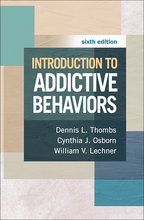
Introduction to Addictive Behaviors
Sixth Edition
Dennis L. Thombs, Cynthia J. Osborn, and William V. Lechner
Hardcovere-bookprint + e-book
Hardcover
orderOctober 12, 2026
ISBN 9781462564248
Price: $70.00 466 Pages
Size: 6" x 9"
e-book
orderSeptember 25, 2026
PDF and Accessible ePub ?
Price: $70.00 466 Pages
ePub is Global Certified Accessible
print + e-book $140.00 $84.00
orderHardcover + e-Book (PDF and Accessible ePub) ?
Price: 466 Pages
ePub is Global Certified Accessible
 Request a free digital professor copy on VitalSource ?
The authoritative text that has helped generations of students and practitioners build foundational knowledge about substance use disorders and other addictive behaviors is now in a revised and updated sixth edition. In one accessible volume, the text comprehensively reviews major theories of addiction and their implications for helping people recover. Keys to evidence-based prevention and treatment are highlighted throughout. Chapters address disease models of addiction; public health and prevention approaches; dual diagnosis; psychoanalytic, behavioral, cognitive, and family systems models; sociocultural approaches; behavioral addictions, such as gambling; and motivational models. Student-friendly features include illustrative clinical vignettes, end-of-chapter summaries, and review questions.
New to This Edition
New to This Edition
- Important developments in research, theory, clinical intervention, and prevention.
- The evolving opioid overdose epidemic, the changing legal landscape of cannabis, and the proliferation of e-cigarette use.
- New or expanded coverage of epigenetics, sociocultural determinants of addiction, and stigma, plus updates on harm reduction, 12-step, and psychoanalytic models.
- Discussions of new diagnoses in ICD-11: gaming disorder and compulsive sexual behavior disorder.
“This is one of the few texts that manage to be equally valuable for both classroom instruction and professional training. The sixth edition belongs on the syllabus of any undergraduate or graduate course in addictions counseling and on the desk of any practitioner seeking a rigorous theoretical grounding. The authors' decision to span disease models, psychoanalytic formulations, conditioning approaches, public health models, and other frameworks in a single, coherent volume reflects the multidisciplinary reality of addiction work. For students and trainees, the updated coverage, accessible writing, clinical examples, and chapter review questions transform complex science into actionable knowledge—precisely what frontline professionals need most.”

—Brian Bride, PhD, MSW, MPH, Hill Crest Foundation Endowed Academic Chair in Mental Health, School of Social Work, University of Alabama
“An outstanding resource for undergraduate and graduate courses in addictions counseling. The sixth edition provides a comprehensive, multidisciplinary examination of addictive behaviors that seamlessly integrates theory, research, prevention, and treatment. The text encourages critical thinking by presenting multiple perspectives on addiction while connecting evidence to practice.”
—Brenda J. Edwards, LPC, NCC, CPCS, MAC, Adjunct Faculty, College of Adult and Professional Studies, Indiana Wesleyan University
“This text is unique in providing a truly comprehensive view of addiction that is understandable to both professionals and students—no easy task for such a complex, multifaceted issue. For public health students, the book offers a broad overview of addictive behaviors as well as strategies to address them at multiple levels. It has particular value for graduate students learning how to apply theory to guide research and practice.”
—Jon Macy, PhD, MPH, Department of Applied Health Science, School of Public Health, Indiana University Bloomington
“A valuable and comprehensive resource for students at both the undergraduate and graduate levels. The sixth edition distinguishes itself with coverage of such topics as co-occurring disorders, reducing stigma, sociocultural factors, emerging issues surrounding behavioral addictions, and current public health concerns. The text encourages students to connect theory and research with the lived realities of addiction across diverse communities and individuals. It equips future practitioners to be competent, compassionate, culturally aware, and effective in increasingly complex clinical environments.”
—Amy Sims, MS, LCADC, MAC, SAP, Adjunct Professor of Human Services, College of Southern Maryland
Table of Contents
Preface
1. Conceptualization of Addictive Behavior and the Need for Informed Practice 
2. The Disease Models
3. Public Health and Prevention Approaches
4. Understanding the Co-Occurrence of Substance Use and Psychiatric Conditions
5. Psychoanalytic Formulations
6. Conditioning Models and Approaches to Contingency Management
7. Cognitive Models
8. The Family System
9. Social and Cultural Foundations
10. The Controversial Science of Behavioral Addiction
11. Promoting Motivation and Autonomy for Personal Change
12. Linking Theory, Evidence, and Practice
References
Author Index
Subject Index
About the Authors
Dennis L. Thombs, PhD, FAAHB, is Distinguished Professor of Public Health (retired) at The University of North Texas Health Science Center in Fort Worth, where he formerly served as Dean of the School of Public Health. Before retiring, his research focus was addictive behavior, with special interests in the conceptualization of addiction and in alcohol and drug use during the period of emerging adulthood. Dr. Thombs is a past president and Fellow of the American Academy of Health Behavior.Cynthia J. Osborn, PhD, LPCC-S, LICDC, is Professor Emerita of Counselor Education and Supervision at Kent State University. Her clinical background is in treatment of adults with co-occurring substance use disorders and mental illness. Before retiring, Dr. Osborn’s teaching, supervision, and scholarship focused on addictions counseling, particularly evidence-based practices such as motivational interviewing. She is a member of the Motivational Interviewing Network of Trainers and has extensive experience in the clinical supervision of counselors-in-training and professional counselors.
William V. Lechner, PhD, is Associate Professor in the Department of Psychological Sciences at Kent State University, where he teaches courses including Drugs and Behavior, Introduction to Psychological Assessment, and Advanced Psychological Assessment. His research focuses on translating human laboratory findings into novel and effective therapeutic interventions for substance use disorders. Dr. Lechner’s work explores the bidirectional relationships between cognitive processes and addictive behaviors, including a recent study examining cognitive training combined with neuromodulation to improve executive functioning relevant to addiction outcomes.
Audience
Students in clinical psychology, counseling, social work, nursing, and public health; beginning alcohol and other drug counselors; practicing mental health and human services professionals without extensive training in addictions.Course Use
Serves as a text in advanced undergraduate- and graduate-level courses such as Addictive Behaviors, Addictions Counseling, Psychology of Addiction, and Treatment of Substance Use Disorders.Previous editions published by Guilford:
Fifth Edition, © 2019
ISBN: 9781462539222
Fourth Edition, © 2013
ISBN: 9781462510689
Third Edition, © 2006
ISBN: 9781593852788
Second Edition, © 1999
ISBN: 9781572304116
First Edition, © 1994
ISBN: 9780898623369
New to this edition:
- Important developments in research, theory, clinical intervention, and prevention.
- The evolving opioid overdose epidemic, the changing legal landscape of cannabis, and the proliferation of e-cigarette use.
- New or expanded coverage of epigenetics, sociocultural determinants of addiction, and stigma, plus updates on harm reduction, 12-step, and psychoanalytic models.
- Discussions of new diagnoses in ICD-11: gaming disorder and compulsive sexual behavior disorder.