Print
Print
 Create flyer
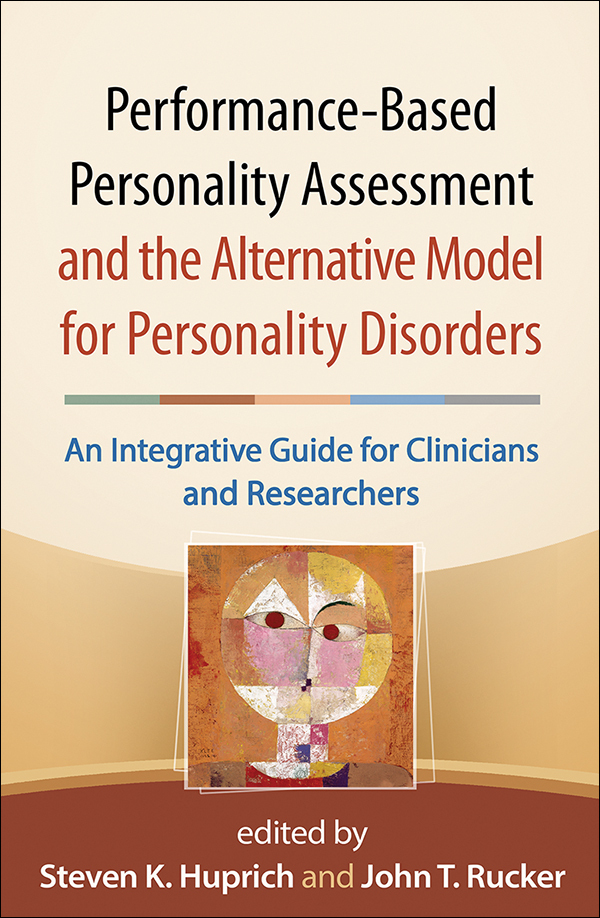
Performance-Based Personality Assessment and the Alternative Model for Personality Disorders
An Integrative Guide for Clinicians and Researchers
Edited by Steven K. Huprich and John T. Rucker
HardcoverPaperbacke-bookprint + e-book
Hardcover
pre-orderApril 5, 2027
ISBN 9781462565887
Price: $113.00 491 Pages
Size: 6" x 9"
Paperback
pre-orderMarch 8, 2027
ISBN 9781462564835
Price: $75.00491 Pages
Size: 6" x 9"
e-book
pre-orderMarch 8, 2027
PDF and Accessible ePub ?
Price: $75.00 491 Pages
ePub is Global Certified Accessible
print + e-book $150.00 $90.00
pre-orderPaperback + e-Book (PDF and Accessible ePub) ?
Price: 491 Pages
ePub is Global Certified Accessible
 Digital professor copy available on VitalSource once published ?
“This landmark volume successfully bridges contemporary dimensional models of personality pathology with the rich clinical tradition of performance-based assessment. As a scientist-practitioner, I have long been waiting for a resource like this. The book offers a sophisticated, systematic integration of the AMPD framework with diverse instruments, such as Rorschach methods, the Thematic Apperception Test, attachment-based measures, sentence completion tests, and projective drawing. The practical guidance and focus on severity of personality dysfunction make this book especially timely for use in training graduate students and clinicians in ICD-11 classification of personality disorder.”

—Bo Bach, PhD, DMSc, Department of Psychology, University of Copenhagen; Center for Personality Disorder Research, Slagelse Psychiatric Hospital, Denmark
“This text captures the commonalities and bidirectional synergy between the AMPD and performance-based multimethod assessment. It illustrates how Criteria A and B both inform and are enriched by performance-based methods. Grounded in robust theory and empirical research, the volume rejects cookie-cutter formulas. Insights from pioneers in the field are combined with extensive clinical examples, providing a flexible scaffolding on ways clinicians can assess for and integrate AMPD language within a multimethod framework. Digestible for graduate students to senior clinicians, this clinically useful book has provided me with additional resources and strategies to incorporate into my teaching and clinical practice.”
—Michelle B Stein, PhD, Department of Psychiatry, Harvard Medical School, Massachusetts General Hospital
“An important and timely contribution. Huprich and Rucker bring together leading clinician-scholars to provide an accessible, empirically informed guide to integrating performance-based methods with the AMPD. Particularly valuable is the book’s emphasis on multimethod assessment—demonstrating how performance-based measures can complement self-report data and illuminate dimensions of personality functioning and/or traits that may otherwise remain less visible. Exemplary clinical applications are provided. This book is essential reading for anyone seeking a nuanced, scientifically grounded approach to understanding personality pathology and advancing evidence-based assessment.”
—Carla Sharp, PhD John and Rebecca Moores Professor and Associate Dean, University of Houston
“This valuable work demonstrates how the criteria from the AMPD can be conceptualized and assessed using tasks of typical performance, such as the Rorschach Performance Assessment System, as opposed to tasks of maximal performance or self-reports of personality. The volume links typical performance measures to the AMPD, explores the use of specific instruments, and uses multimethod cases to illustrate degrees of severity in personality disorder psychopathology and to address particular assessment contexts. This unique and helpful text is a crucial resource for clinical assessment students, practitioners, and researchers.”
—Gregory J. Meyer, PhD, Professor Emeritus, Department of Psychology, University of Toledo
—Bo Bach, PhD, DMSc, Department of Psychology, University of Copenhagen; Center for Personality Disorder Research, Slagelse Psychiatric Hospital, Denmark
“This text captures the commonalities and bidirectional synergy between the AMPD and performance-based multimethod assessment. It illustrates how Criteria A and B both inform and are enriched by performance-based methods. Grounded in robust theory and empirical research, the volume rejects cookie-cutter formulas. Insights from pioneers in the field are combined with extensive clinical examples, providing a flexible scaffolding on ways clinicians can assess for and integrate AMPD language within a multimethod framework. Digestible for graduate students to senior clinicians, this clinically useful book has provided me with additional resources and strategies to incorporate into my teaching and clinical practice.”
—Michelle B Stein, PhD, Department of Psychiatry, Harvard Medical School, Massachusetts General Hospital
“An important and timely contribution. Huprich and Rucker bring together leading clinician-scholars to provide an accessible, empirically informed guide to integrating performance-based methods with the AMPD. Particularly valuable is the book’s emphasis on multimethod assessment—demonstrating how performance-based measures can complement self-report data and illuminate dimensions of personality functioning and/or traits that may otherwise remain less visible. Exemplary clinical applications are provided. This book is essential reading for anyone seeking a nuanced, scientifically grounded approach to understanding personality pathology and advancing evidence-based assessment.”
—Carla Sharp, PhD John and Rebecca Moores Professor and Associate Dean, University of Houston
“This valuable work demonstrates how the criteria from the AMPD can be conceptualized and assessed using tasks of typical performance, such as the Rorschach Performance Assessment System, as opposed to tasks of maximal performance or self-reports of personality. The volume links typical performance measures to the AMPD, explores the use of specific instruments, and uses multimethod cases to illustrate degrees of severity in personality disorder psychopathology and to address particular assessment contexts. This unique and helpful text is a crucial resource for clinical assessment students, practitioners, and researchers.”
—Gregory J. Meyer, PhD, Professor Emeritus, Department of Psychology, University of Toledo