Print
Print
 Create flyer
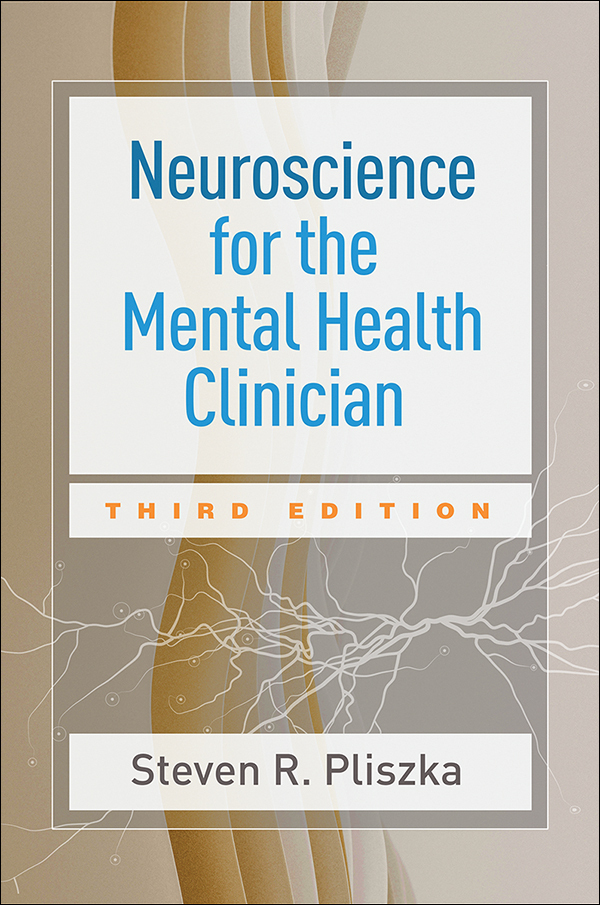
Neuroscience for the Mental Health Clinician
Third Edition
Steven R. Pliszka
HardcoverPaperbacke-bookprint + e-book
Hardcover
pre-orderJanuary 29, 2027
ISBN 9781462565160
Price: $74.00 375 Pages
Size: 7" x 10"
Paperback
pre-orderJanuary 1, 2027
ISBN 9781462564828
Price: $49.00375 Pages
Size: 7" x 10"
e-book
pre-orderJanuary 1, 2027
PDF and Accessible ePub ?
Price: $49.00 375 Pages
ePub is Global Certified Accessible
print + e-book $98.00 $58.80
pre-orderPaperback + e-Book (PDF and Accessible ePub) ?
Price: 375 Pages
ePub is Global Certified Accessible
 Digital professor copy available on VitalSource once published ?
The new edition will be published January 1, 2027. If you need this title before then, please see the previous edition.
“An extremely valuable introduction to the neurobiology of psychiatric disorders. I highly recommend it to anyone interested in understanding the neurobiological basis of psychiatric disorders.”

—Doody's Review Service (on the second edition)
“This is an excellent book.”
—Bulletin of the Menninger Clinic (on the first edition)
“The material in this book is highly relevant....I would like to see this book as required reading for all our medical students and psychiatric residents and would highly recommend it to biologically oriented psychologists, doctoral-level pharmacists, and other suitably prepared students and clinicians.”
—Psychiatric Services (on the first edition)
“An important introductory resource for mental health clinicians who are interested in understanding how neurobiological advances can lead to new treatment and social policies for those who suffer from mental illness....The author has done a commendable job in trying to describe, in simple language, how the brain influences behavior and what impact that has on our understanding of the etiology of mental illness.”
—Psychological Medicine (on the first edition)
“This book is well written and crafted in an engaging style that captures the reader's attention....The book does an excellent job of covering as much as possible on an extremely broad and intricate topic....An excellent book that is highly recommended for all mental health professionals. It is also a great introductory text for teaching in psychiatric residency programs, particularly for residents who are interested in the study of genetics and mental illness.”
—Archives of Psychiatry and Psychotherapy (on the first edition)
“Dr. Pliszka has made an important contribution in helping mental health clinicians to orient themselves to the imperatives of neuroscience and the possibilities for future advancement.”
—Community Mental Health Journal (on the first edition)
“Written by a leading psychiatrist, this indispensable resource seamlessly bridges cutting-edge neurobiology with practical clinical application. The third edition captures a decade of revolutionary breakthroughs in the areas of multi-node neural networks, neuroimmunology, clinical genetics, machine learning, and more. Pliszka avoids oversimplification, arming practitioners with the nuances needed to debunk psychiatric misconceptions. The figures and tables are meticulously designed to offer exceptional utility. Clinicians gain the scientific literacy required to confidently explain complex neurobiological mechanisms to patients and to guide evidence-based treatment decisions. For advanced clinical training, graduate-level psychopathology courses, or psychiatry residencies, this text provides a fine instructional framework.”
—Stephen V. Faraone, PhD, Distinguished Professor, Department of Psychiatry, State University of New York Upstate Medical University
“Every practicing mental health provider should have a copy of this book. To fully understand the biological bases of the conditions we treat is to offer a higher standard of care to our patients. The third edition distills the latest science on the neurobiology of common mental disorders, translating complexities into usable psychoeducation. It is fascinating to read, going beyond basics to timely topics such as genetics, inflammation, and hormonal influences on the brain. A great refresher and update for professionals!”
—Margaret Sibley, PhD, Department of Psychiatry and Behavioral Sciences, University of Washington School of Medicine
—Doody's Review Service (on the second edition)
“This is an excellent book.”
—Bulletin of the Menninger Clinic (on the first edition)
“The material in this book is highly relevant....I would like to see this book as required reading for all our medical students and psychiatric residents and would highly recommend it to biologically oriented psychologists, doctoral-level pharmacists, and other suitably prepared students and clinicians.”
—Psychiatric Services (on the first edition)
“An important introductory resource for mental health clinicians who are interested in understanding how neurobiological advances can lead to new treatment and social policies for those who suffer from mental illness....The author has done a commendable job in trying to describe, in simple language, how the brain influences behavior and what impact that has on our understanding of the etiology of mental illness.”
—Psychological Medicine (on the first edition)
“This book is well written and crafted in an engaging style that captures the reader's attention....The book does an excellent job of covering as much as possible on an extremely broad and intricate topic....An excellent book that is highly recommended for all mental health professionals. It is also a great introductory text for teaching in psychiatric residency programs, particularly for residents who are interested in the study of genetics and mental illness.”
—Archives of Psychiatry and Psychotherapy (on the first edition)
“Dr. Pliszka has made an important contribution in helping mental health clinicians to orient themselves to the imperatives of neuroscience and the possibilities for future advancement.”
—Community Mental Health Journal (on the first edition)
“Written by a leading psychiatrist, this indispensable resource seamlessly bridges cutting-edge neurobiology with practical clinical application. The third edition captures a decade of revolutionary breakthroughs in the areas of multi-node neural networks, neuroimmunology, clinical genetics, machine learning, and more. Pliszka avoids oversimplification, arming practitioners with the nuances needed to debunk psychiatric misconceptions. The figures and tables are meticulously designed to offer exceptional utility. Clinicians gain the scientific literacy required to confidently explain complex neurobiological mechanisms to patients and to guide evidence-based treatment decisions. For advanced clinical training, graduate-level psychopathology courses, or psychiatry residencies, this text provides a fine instructional framework.”
—Stephen V. Faraone, PhD, Distinguished Professor, Department of Psychiatry, State University of New York Upstate Medical University
“Every practicing mental health provider should have a copy of this book. To fully understand the biological bases of the conditions we treat is to offer a higher standard of care to our patients. The third edition distills the latest science on the neurobiology of common mental disorders, translating complexities into usable psychoeducation. It is fascinating to read, going beyond basics to timely topics such as genetics, inflammation, and hormonal influences on the brain. A great refresher and update for professionals!”
—Margaret Sibley, PhD, Department of Psychiatry and Behavioral Sciences, University of Washington School of Medicine