Print
Print
 Create flyer
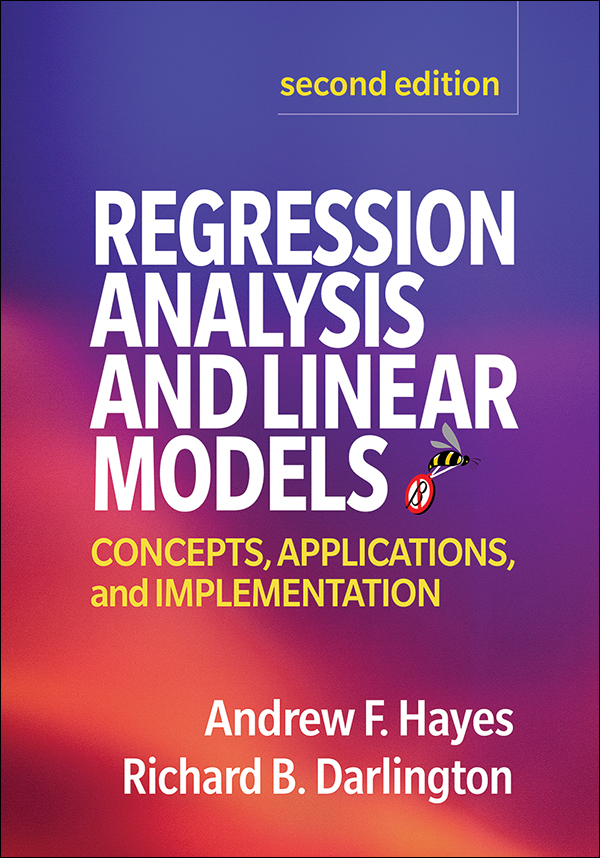
Regression Analysis and Linear Models
Second Edition
Concepts, Applications, and Implementation
Andrew F. Hayes and Richard B. Darlington
Hardcovere-bookprint + e-book
Hardcover
pre-orderApril 1, 2027
ISBN 9781462567041
Price: $98.00 600 Pages
Size: 7" x 10"
 Digital professor copy available on VitalSource once published ?
The new edition will be published April 1, 2027. If you need this title before then, please see the previous edition.
Popular for its engaging writing and diverse, worked-through examples; helpful tips and cautions; and emphasis on conceptual understanding over mathematics, this introduction to linear regression analysis has been updated and reorganized for greater accessibility. Andrew F. Hayes and Richard B. Darlington introduce regression through the concept of statistical control of covariates. They explicate model construction and estimation, quantification and measurement of multivariate and partial association, group comparisons, use of multicategorical variables, mediation and path analysis, regression diagnostics, and many other important topics. Now with R code available throughout the book, along with SPSS, SAS, and Stata, the second edition includes separate chapters on model estimation/partial regression coefficients and partial association, including unpacking the important difference between semipartial and partial correlation. The companion website (www.afhayes.com) provides data files and code for the book's examples, along with online-only appendices on Hayes's PROCESS macro for regression analysis and on using regression as a prediction system.
New to This Edition
New to This Edition
- New material on estimating, probing, and visualizing interactions in a regression model; simplifying a mediation analysis, especially for the construction of confidence intervals for inference about indirect effects; conducting a qualitative dominance analysis; and more.
- Incorporates use of the PROCESS macro for regression analysis, which makes it easier for users of different software to learn and share syntax across computing platforms.
- R code is now available throughout the book, along with SPSS, SAS and Stata.
This title is part of the Methodology in the Social Sciences Series, edited by Todd D. Little, PhD.