Print
Print
 Create flyer
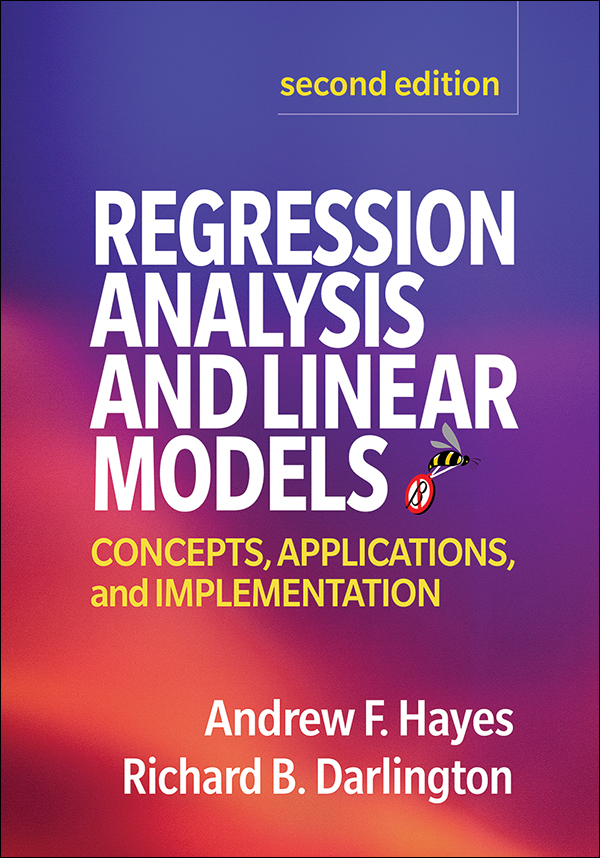
Regression Analysis and Linear Models
Second Edition
Concepts, Applications, and Implementation
Andrew F. Hayes and Richard B. Darlington
Hardcovere-bookprint + e-book
Hardcover
pre-orderApril 1, 2027
ISBN 9781462567041
Price: $98.00 600 Pages
Size: 7" x 10"
 Digital professor copy available on VitalSource once published ?
The new edition will be published April 1, 2027. If you need this title before then, please see the previous edition.
“This book is an excellent choice for a first course in general linear models because it prioritizes students' conceptual understanding of regression and its underlying architecture. Key concepts are developed through conceptual formulas, geometric representations, clear explanations, and substantive examples. The second edition further advances this goal with expanded descriptions of complex concepts. Along the way, the authors address controversies and common misunderstandings in the application and interpretation of regression models and offer defensible paths forward. By presenting important concepts in a variety of ways, the text helps students build a deeper and more intuitive understanding of regression modeling.”

—Timothy R. Konold, PhD, Curry Memorial Professor of Education, University of Virginia
“I am a big fan of the first edition, which I’ve used for several years in teaching general linear models to graduate students in the educational and social sciences. I am happy to see the authors continue their outstanding work in a second edition that now includes R syntax in addition to SPSS, SAS, and Stata. This comprehensive yet highly readable text provides a modern, thoughtful treatment with many highlights, such as useful coding options for categorical predictors into regression, how interaction terms generate conditional slopes, many options for nonlinear relations, and a thorough comparison of effect size measures (including a pie analogy I readily borrow). I recommend this text highly for use in any class focused on the meaningful application of general linear models for research purposes.”
—Lesa Hoffman, PhD, Eugene T. Moore Distinguished Professor, Department of Education and Human Development, Clemson University
“I have used the first edition of this book continuously since 2017, and I am delighted to see the second edition. The greater focus on R content in each chapter is an important upgrade given the ubiquity of R in modern data analysis. There is also stronger integration of PROCESS into this edition, which deepens the connection between this text and common practices of testing mediation and moderation. This text is an important resource for graduate students and professionals looking to understand the basic principles of regression as well as extensions to categorical predictors, tests of moderation, and analyses of indirect effects.”
—Jeffrey H. Kahn, PhD, Department of Psychology, Illinois State University
“I relied for many years on the first edition as the primary text in my psychology graduate classes covering fundamentals of general linear models. The updated second edition is the perfect all-in-one solution for students with a basic undergraduate statistics background. This book excels at explaining in plain language complex topics that don’t get enough attention in traditional statistics texts. Beyond the basics of regression and its correspondence with ANOVA, the second edition provides detailed guidance on interpreting partial effects, understanding regression to the mean, and appreciating collider bias when choosing control variables, as well as expanded content on testing and probing interactions. I recommend this book not only as a text for graduate statistics classes, but also as a comprehensive, go-to linear models reference for social science researchers at all career stages.”
—Andrea L. Howard, PhD, Department of Psychology, Carleton University, Canada
—Timothy R. Konold, PhD, Curry Memorial Professor of Education, University of Virginia
“I am a big fan of the first edition, which I’ve used for several years in teaching general linear models to graduate students in the educational and social sciences. I am happy to see the authors continue their outstanding work in a second edition that now includes R syntax in addition to SPSS, SAS, and Stata. This comprehensive yet highly readable text provides a modern, thoughtful treatment with many highlights, such as useful coding options for categorical predictors into regression, how interaction terms generate conditional slopes, many options for nonlinear relations, and a thorough comparison of effect size measures (including a pie analogy I readily borrow). I recommend this text highly for use in any class focused on the meaningful application of general linear models for research purposes.”
—Lesa Hoffman, PhD, Eugene T. Moore Distinguished Professor, Department of Education and Human Development, Clemson University
“I have used the first edition of this book continuously since 2017, and I am delighted to see the second edition. The greater focus on R content in each chapter is an important upgrade given the ubiquity of R in modern data analysis. There is also stronger integration of PROCESS into this edition, which deepens the connection between this text and common practices of testing mediation and moderation. This text is an important resource for graduate students and professionals looking to understand the basic principles of regression as well as extensions to categorical predictors, tests of moderation, and analyses of indirect effects.”
—Jeffrey H. Kahn, PhD, Department of Psychology, Illinois State University
“I relied for many years on the first edition as the primary text in my psychology graduate classes covering fundamentals of general linear models. The updated second edition is the perfect all-in-one solution for students with a basic undergraduate statistics background. This book excels at explaining in plain language complex topics that don’t get enough attention in traditional statistics texts. Beyond the basics of regression and its correspondence with ANOVA, the second edition provides detailed guidance on interpreting partial effects, understanding regression to the mean, and appreciating collider bias when choosing control variables, as well as expanded content on testing and probing interactions. I recommend this book not only as a text for graduate statistics classes, but also as a comprehensive, go-to linear models reference for social science researchers at all career stages.”
—Andrea L. Howard, PhD, Department of Psychology, Carleton University, Canada