Print
Print
 Create flyer
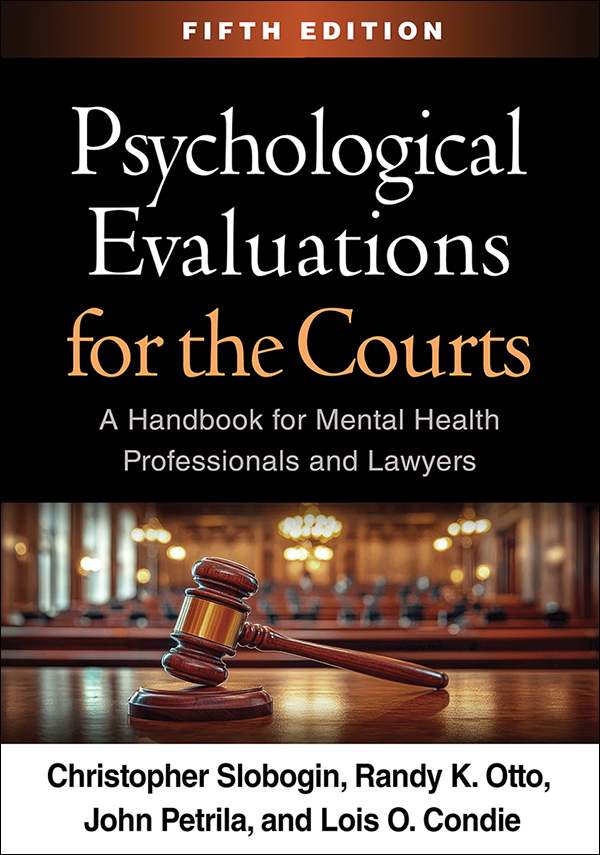
Psychological Evaluations for the Courts
Fifth Edition
A Handbook for Mental Health Professionals and Lawyers
Christopher Slobogin, Randy K. Otto, John Petrila, and Lois O. Condie
 Request a free digital professor copy on VitalSource ?
Professors: Do you need to make an adoption decision or update your syllabus for the next term? Request a set of page proofs now for immediate review.
Read a Q&A with featured author, Christopher Slobogin!
1. Law and the Mental Health Professions: An Uneasy Alliance 
1.01. The Context for Law and Behavioral Science
1.02. Some Preliminary Problems in Law and Mental Health
1.03. Paradigm Conflicts
1.04. Should Mental Health Professionals Be Considered Experts?
1.05. Which Professionals Should Be Considered Experts?
1.06. Conclusion
2. An Overview of the Legal System: Sources of Law, the Court System, and the Adjudicative Process
2.01. Introduction
2.02. Sources of Law
2.03. The Court System
2.04. The Adjudicative Process
2.05. Conclusion: The Interplay of Systems
3. The Nature and Method of Forensic Assessment
3.01. Introduction
3.02. Distinctions between Therapeutic and Forensic Assessment
3.03. Testing and Assessment Procedures
3.04. Archival and Third-Party Information
3.05. Amnesia
3.06. Assessment of Response Style
3.07. Cultural Competence
3.08. Challenges to the Basis of Expert Testimony
3.09. The Implications of Artificial Intelligence for Forensic Practice
3.10. Conclusion
4. Constitutional, Common-Law, and Ethical Contours of the Evaluation Process:
The Mental Health Professional as Double Agent
4.01. Introduction
4.02. The Fifth Amendment and the Right to Remain Silent
4.03. The Right to Counsel
4.04. Common-Law and Statutory Duties of the Evaluator
4.05. Ethical Considerations in the Evaluation Process
4.06. Summary: Competence in Forensic Practice
5. Managing Public and Private Forensic Services
5.01. Introduction
5.02. The Case for Specialization3
5.03. Types of Evaluation Systems for Criminal Cases
5.04. Establishing a Forensic Evaluation System
5.05. Effective Diffusion of Behavioral Science Research
5.06. Operating a Forensic Practice
II. The Criminal Process
6. Competence to Proceed
6.01. Introduction
6.02. The Legal Standard
6.03. Procedural Issues
6.04. Disposition of Incompetent Defendants
6.05. Competence During Proceedings Other Than Trial or Plea Hearings
6.06. Research Relating to Competence Evaluations
6.07. Structured Evaluation Formats
6.08. Special Populations
6.09. Guidelines for Evaluation
6.10. Conclusion
7. Other Competencies in the Criminal Process
7.01. Introduction
7.02. Competence to Consent to a Search or Seizure
7.03. Competence to Exercise the Right to Remain Silent
7.04. Competence to Plead Guilty
7.05. Competence to Waive the Right to Counsel and to Represent Oneself
7.06. Competence to Refuse an Insanity Defense and Other Mental State Defenses
7.07. Competence to Testify
7.08. Competence to Be Executed and to Participate in and Waive Appeals
8. Mental State at the Time of the Offense
8.01. Introduction
8.02. The Insanity Defense
8.03. Exculpatory and Mitigating Doctrines Other than Insanity
8.04. Research on the Relationship of Diagnosis to MSO Defenses
8.05. Characteristics of Clinicians’ MSO Opinions
8.06. MSO Investigation
8.07. Clinical Formulations about MSO
8.08. Conclusion
9. Sentencing
9.01. Introduction
9.02. A Brief History of Sentencing
9.03. A Comparison of Rehabilitative and Retributive Sentencing
9.04. Special Sentencing Provisions
9.05. Capital Sentencing
9.06. Factors Influencing Sentencing
9.07. Assessment of Treatment Needs
9.08. Assessment of Culpability
9.09. Assessing Risk of Violence and Recidivism
III. Noncriminal Adjudication
10. Civil Commitment
10.01. Introduction
10.02. History of Commitment Law
10.03. Substantive Criteria for Commitment
10.04. Procedural Due Process
10.05. The Effects of Commitment Laws and Commitment
10.06. Attorney’s Role
10.07. Clinician’s Role
10.08. Commitment Evaluation
10.09. The Process of the Evaluation
10.10. Special Commitment Settings and Populations
11. Civil Competencies
11.01. Introduction
11.02. Guardianship
11.03. Competence to Make Treatment Decisions
11.04. Competence to Consent to Research
11.05. Testamentary Capacity
12. Compensating Mental Injury: Workers’ Compensation and Torts
12.01. Introduction
12.02. Workers’ Compensation Law: An Overview
12.03. The Tort of Emotional Distress
12.04. Causation in Mental Injury Cases: A Paradigm Clash?
12.05. Clinical Evaluation of Mental Injury
12.06. Conclusion: Reports and Testimony
13. Federal Antidiscrimination, Entitlement, and Immigration Laws
13.01. Introduction
13.02. Americans with Disabilities Act
13.03. Fair Housing Amendments Act
13.04. Social Security Laws
13.05. Immigration Law
13.06. Conclusion
IV. Children and Families
14. Juvenile Delinquency
14.01. Introduction
14.02. The Rise and Fall of the “Therapeutic” Juvenile Court
14.03. The Nature of the Juvenile Process
14.04. Mental Health Professionals’ Roles in Juvenile Court116
14.05. The Nature of the Evaluation
14.07. Special Juvenile Populations
14.08. Do the Mental Health and Juvenile Systems Belong Together?
15. Child Abuse and Neglect
15.01. The Nature of Abuse and Neglect Proceedings
15.02. Legal Definitions of Child Maltreatment
15.03. Child Maltreatment as a Clinical Phenomenon
15.04. Clinicians’ Involvement in the Legal Process
15.05. Special Populations
15.06. The Methodology of Abuse/Neglect Evaluations
15.07. Adult Cases Related to Abuse and Neglect
16. Child Custody in Divorce
16.01. The Scope of Clinicians’ Involvement in Custody Disputes
16.02. Standards for Resolution of Custody Disputes
16.03. Research Data Relevant to Custody Matters
16.04. The Technique of Custody Evaluations
16.05. The Politics of Divorce
17. Education and Habilitation
17.01. Introduction
17.02. The Impetus for the IDEA
17.03. The Structure of the IDEA
17.04. Clinical Evaluation under the Act
17.05. Conclusion
V. Communicating with the Courts
18. Consultation, Report Writing, and Expert Testimony
18.01. Introduction
18.02. Preliminary Consultations
18.03. Data Collection, Maintenance, and Disclosure
18.04. Preliminary Report of Findings
18.05. Report Writing
18.06. Expert Testimony and the Social Psychology of Persuasion
18.07. The Ultimate-Issue Issue
18.08. Conclusion
19. Sample Reports
19.01. Introduction
19.02. Competence to Proceed
19.03. Competence to Plead and Waive Rights
19.04. Mental State at the Time of the Offense
19.05. Sentencing
19.06. Civil Commitment
19.07. Competence to Handle Finances
19.08. Workers’ Compensation for Mental Injury
19.09. Reasonable Accommodation under the Americans with Disabilities Act
19.10. Consultative Examination for Social Security
19.11. Immigration Status
19.12. Transfer to Adult Court
19.13. Dispositional Review
19.14. Custody
19.15. Evaluation under the Individuals with Disabilities Education Act
20. Glossary
20.01. Legal Terms
20.02. Clinical and Research Terms
Notes
Index